Before we define differential forms, we examine the symmetry property of tensors. The symmetry operation on a tensor is defined by
where and is an element of , the symmetric group of order . Take the coordinate basis . The component of in this basis is
The component of is obtained from (5.59) as
For a general tensor of type , the symmetry operations are defined for indices and indices separately.
For , the symmetrizer is defined by
while the anti-symmetrizer is
where for even permutations and for odd permutations. is totally symmetric (that is, for any ) and is totally antisymmetric ( ).
5.4.1 Definitions
A differential form of order or an -form is a totally anti-symmetric tensor of type .
Let us define the wedge product of one-forms by the totally anti-symmetric tensor product
For example,
It is readily verified that the wedge product satisfies the following.
(i) if some index appears at least twice.
(ii)
(iii) is linear in each
If we denote the vector space of -forms at by , the set of -forms (5.62) forms a basis of and an element is expanded as
where are taken totally anti-symmetric, reflecting the anti-symmetry of the basis. For example, the components of any second-rank tensor are decomposed into the symmetric part and the anti-symmetric part :
Observe that , while
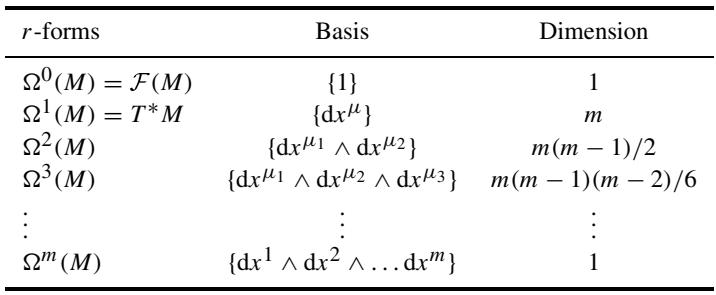
Since there are choices of the set out of in (5.62), the dimension of the vector space is
For later convenience we define . Clearly . If in (5.62) exceeds , it vanishes identically since some index appears at least twice in the anti-symmetrized summation. The equality implies . Since is a vector space, is isomorphic to (see section 2.2).
Define the exterior product of a -form and an -form by a trivial extension. Let and , for example. The action of the -form on vectors is defined by
where . If , vanishes identically. With this product, we define an algebra
is the space of all differential forms at and is closed under the exterior product.
Take the Cartesian coordinates in . The two-form is the oriented area element (the vector product in elementary vector algebra). Show that, in polar coordinates, this becomes .
Let , and . Show that
We may assign an -form smoothly at each point on a manifold . We denote the space of smooth -forms on by . We also define to be the algebra of smooth functions, . In summary we have table 5.1.
Table 5.1.
5.4.2 Exterior derivatives
The exterior derivative is a map whose action on an -form
is defined by
It is common to drop the subscript and write simply d. The wedge product automatically anti-symmetrizes the coefficient.
The -forms in three-dimensional space are:
(i)
(ii)
(iii) and
(iv)If we define an axial vector by , a two-form may be regarded as a ‘vector’. The Levi-Civita symbol is defined by and provides the isomorphism between and . [Note that both of these are of dimension three.]
The action of is
(i)
(ii)
(iii) and
(iv)Hence, the action of on is identified with ‘grad’, on with ‘rot’ and on with ‘div’ in the usual vector calculus.
Let and . Show that
A useful expression for the exterior derivative is obtained as follows. Let us take and . It is easy to see that the combination
is equal to , and we have the coordinate-free expression
For an -form , this becomes
where the entry below has been omitted. As an exercise, the reader should verify (5.71) explicitly for .
We now prove an important formula:
Take
The action of on is
This vanishes identically since is symmetric with respect to and while is anti-symmetric.
It is known that the electromagnetic potential is a one-form, (see chapter 10). The electromagnetic tensor is defined by and has the components
where
as usual. Two Maxwell equations, and follow from the identity , which is known as the Bianchi identity, while the other set is the equation of motion derived from the Lagrangian (1.245).
A map induces the pullback and is naturally extended to tensors of type ; see section 5.2. Since an -form is a tensor of type , this applies as well. Let and let be a map . At each point , induces the pullback by
where and is the differential map
Let and let . Show that
The exterior derivative induces the sequence
where is the inclusion map . This sequence is called the de Rham complex. Since , we have . [Take . Then and imply .] An element of is called a closed -form, while an element of is called an exact -form. Namely, is closed if and exact if there exists an -form such that . The quotient space is called the th de Rham cohomology group which is made into the dual space of the homology group; see chapter 6.
5.4.3 Interior product and Lie derivative of forms
Another important operation is the interior product where . For , we define
For and we have
where the entry below has been omitted. For example, let be the coordinates of . Then
The Lie derivative of a form is most neatly written with the interior product. Let be a one-form. Consider the combination
Comparing this with (5.55), we find that
For a general -form , we have
We also have
If we interchange the roles of and in the first term of the last expression and compare it with (5.81), we verify that
for any -form .
Let and . Show that
Show also that is an anti-derivation,
and nilpotent,
Use the nilpotency to prove
Let . Show that
Let us reformulate Hamiltonian mechanics (section 1.1) in terms of differential forms. Let be a Hamiltonian and be its phase space. Define a two-form
called the symplectic two-form. If we introduce a one-form
the symplectic two-form is expressed as
Given a function in the phase space, one can define the Hamiltonian vector field
Then it is easy to verify that
Consider a vector field generated by the Hamiltonian
For the solution to Hamilton’s equation of motion
we also obtain
The symplectic two-form is left invariant along the flow generated by
where use has been made of (5.82). Conversely, if satisfies , there exists a Hamiltonian such that Hamilton’s equation of motion is satisfied
along the flow generated by . This follows from the previous observation that and hence by Poincaré’s lemma, there exists a function such that
The Poisson bracket is cast into a form independent of the special coordinates chosen with the help of the Hamiltonian vector fields. In fact,
来源与版本
正文:英文 · OCR 机器稿 · 待校对
核对状态:OCR 机器稿 · 待校对
来源版本:second-edition-local
来源 PDF SHA-256:fcd24c3371d092a8c699ccf5cf0765462924b6c48412804231076e8084b1940d
OCR 来源 SHA-256:0b6324f01172a3548cd34382e82fd8bfae574602b6b2cfaa357ba96bc2c35478
OCR 产物 SHA-256:9ccf560be2dffc1c39f12dabd141340fe85bfad73a2a66c1036542c58479895a