21.1 Quantum particle in a central potential
Concept links · terms present in this machine draft; source roles are unverified: eigenvalue · irreducible representation · group action
In classical physics, to describe not free particles, but particles experiencing some sort of force, one just needs to add a “potential energy” term to the kinetic energy term in the expression for the energy (the Hamiltonian function). In one dimension, for potential energies that just depend on position, one has
for some function . In the physical case of three dimensions, this will be
Quantizing and using the Schr¨odinger representation, the Hamiltonian op-
erator for a particle moving in a potential will be
We will be interested in so-called “central potentials”, potential functions that are functions only of , and thus only depend upon the radial distance to the origin. For such , both terms in the Hamiltonian will be invariant, and eigenspaces of H will be representations of 3).
Using the expressions for the angular momentum operators in spherical coordinates derived in chapter 8 (including equation 8.4 for the Casimir operator , one can show that the Laplacian has the following expression in spherical coordinates
The Casimir operator has eigenvalues on irreducible representations of dimension (integral spin ). restricted to such an irreducible representation, we have
To solve the Schr¨odinger equation, we want to find the eigenfunctions of . The space of eigenfunctions of energy E will be a sum of irreducible representations of , with the acting on the angular coordinates of the wavefunctions, leaving the radial coordinate invariant. To find eigenfunctions of the Hamiltonian t2
we can first look for functions , depending on . and the energy eigenvalue , and satisfying
Turning to the angular coordinates, we have seen in chapter 8 that representations of on functions of angular coordinates can be explicitly expressed in terms of the spherical harmonic functions , on which acts with eigenvalue . For each solution we will have the eigenvalue equation
and the
will span a dimensional (since space of energy eigenfunctions for H of eigenvalue
For a general potential function , exact solutions for the eigenvalues E and corresponding functions cannot be found in closed form. One special case where we can find such solutions is for the three dimensional harmonic oscillator, where . These are much more easily found though using the creation and annihilation operator techniques to be discussed in chapter 22.
The other well known and physically very important such case is the case of potential, called the Coulomb potential. This describes a light charged particle moving in the potential due to the electric field of a much heavier charged particle, a situation that corresponds closely to that of a hydrogen atom. In this case we have 2
where is the charge of the electron, so we are looking for solutions to
Since on functions
multiplying both sides of equation 21.1 by gives
The solutions to this equation can be found through a rather elaborate process described in most quantum mechanics textbooks, which involves looking for a power series solution. For there are non-normalizable solutions that describe scattering phenomena that we won’t study here. For solutions correspond to an integer with . So, for each n we get n solutions, with , all with the same energy
A plot of the diferent energy eigenstates looks like this:
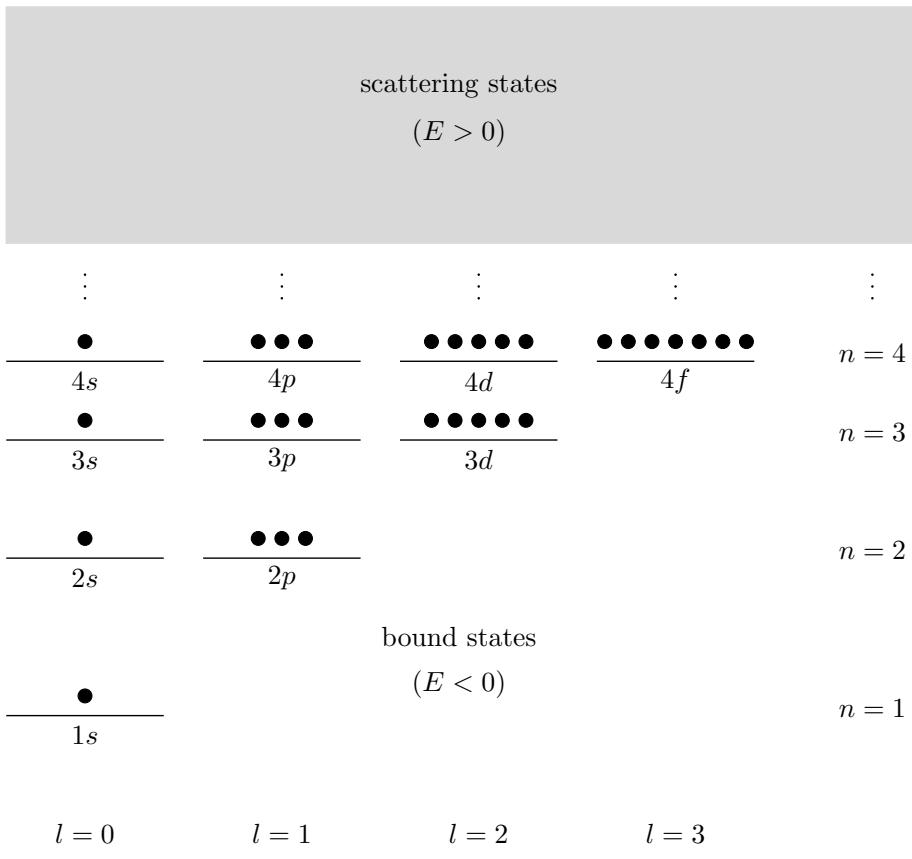
Figure 21.1: Energy eigenstates in the Coulomb potential.
The degeneracy in the energy values leads one to suspect that there is some extra group action in the problem commuting with the Hamiltonian. If so, the eigenspaces of energy eigenfunctions will come in irreducible representations of some larger group than SO(3). If the representation of the larger group is reducible when one restricts to the subgroup, giving n copies of the representation of spin , that would explain the pattern observed here. In the next section we will see that this is the case, and there use representation theory to derive the above formula for
We won’t go through the process of showing how to explicitly find the functions but just quote the result. Setting
(this has dimensions of length and is known as the “Bohr radius”), and defining
the solutions are of the form
where the are certain polynomials known as associated Laguerre polynomials.
So, finally, we have found energy eigenfunctions
for
The first few of these, properly normalized, are
(called the 1S state, meaning
(called the 2S state), and the three dimensional (called meaning states with basis elements
来源与版本
正文:英文 · OCR 机器稿 · 待校对
核对状态:OCR 机器稿 · 待校对
原书 PDF · 印刷页 234、235、236、237、238、239、240、241、242、243
来源版本:2025-10-20
来源 PDF SHA-256:5a1941b2443b54d5db3d055f1e5ba390429b7a728475258017aaac87ee85a837
OCR 来源 SHA-256:f864b39e9a9849d1d648bb935f244bba8018506db5ba7fbcf902cc31def39dd7
OCR 产物 SHA-256:f864b39e9a9849d1d648bb935f244bba8018506db5ba7fbcf902cc31def39dd7