43.1 The Klein-Gordon equation and its solutions
Concept links · terms present in this machine draft; source roles are unverified: irreducible representation · group action
To get a single-particle theory describing an elementary particle with a unitary action of the Poincar´e group, one can try to take as single-particle state space any of the irreducible representations classified in chapter 42. There we found that such irreducible representations are characterized in part by the scalar value that the Casimir operator takes on the representation. When this is negative, we have the operator equation
and we would like to find a state space with momentum operators satisfying this relation. We can use wavefunctions on Minkowski space to get such a state space.
Just as in the non-relativistic case, where we could represent momentum operators as either multiplication operators on functions of the momenta, or diferentiation operators on functions of the positions, here we can do the same, with functions now depending on the four space-time coordinates. Taking as well as the conventional momentum operators , equation 43.1 becomes:
Definition (Klein-Gordon equation)
The Klein-Gordon equation is the secondorder partial diferential equation
or
for functions on Minkowski space (these functions may be real or complexvalued).
This equation is the simplest Lorentz invariant (the Lorentz group acting on functions takes solutions to solutions) wave equation, and historically was the one first tried by Schr¨odinger. He soon realized it could not account for known facts about atomic spectra and instead used the non-relativistic equation that bears his name. In this chapter we will consider the quantization of the space of real-valued solutions of this equation, with the case of complex-valued solutions appearing later in section 44.1.2.
Taking Fourier transforms by
the momentum operators become multiplication operators, and the Klein-Gordon equation is now
where
Solutions to this will be distributions that are non-zero only on the hyperboloid
in energy-momentum space . This hyperboloid has two components, with positive and negative energy
Ignoring one dimension, these look like
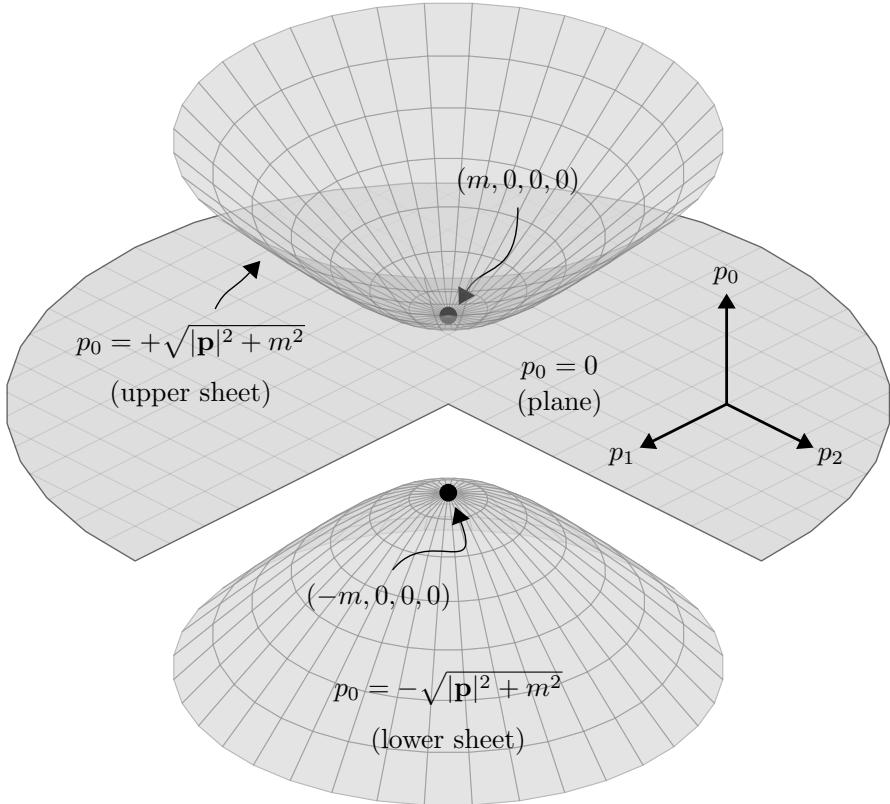
Figure 43.1: Orbits of energy-momentum vectors and under the Poincar´e group action.
and are the orbits of the energy-momentum vectors and under the Poincar´e group action discussed in sections 42.3.1 and 42.3.2.
In the non-relativistic case, a continuous basis of solutions of the free particle Schr¨odinger equation labeled by was given by the functions
with a general solution a superposition of these given by
Besides specifying the function , elements of the single-particle space could be uniquely characterized in two other ways by a function on : either the initial value or its Fourier transform
In the relativistic case, since the Klein-Gordon equation is second order in time, solutions will be parametrized by initial data which, unlike the non-relativistic case, now requires the specification at of not one, but two functions:
the values of the field and its first time derivative.
In the relativistic case a continuous basis of solutions of the Klein-Gordon equation will be given by the functions
and a general solution can be written
for a complex function satisfying (so that will be real). The solution will only depend on the values f takes on the hyperboloids
The integral 43.3 is expressed in a four dimensional, Lorentz invariant manner using the delta-function, but this is really an integral over the two-component hyperboloid. This can be rewritten as a three dimensional integral over by the following argument. For each p, applying equation 11.9 to the case of the function of given by
on , and using
gives
We will often in the future use the above to provide a Lorentz invariant measure on the hyperboloids , which we’ll write
For a function on these hyperboloids the integral over the hyperboloids can be written in two equivalent ways
with the left-hand side an explicitly Lorentz invariant measure (since is Lorentz invariant).
An arbitrary solution of the Klein-Gordon equation (see equation 43.3) can thus be written
which will be real when
Instead of the functions we will usually instead use
Other choices of normalization of these complex functions are often used, the motivation for this one is that we will see that it will give simple Poisson bracket relations. With this choice, the Klein-Gordon solutions are
Such solutions can be specified in terms of their initial data by either the pair of real-valued functions , or their Fourier transforms. We will however find it much more convenient to characterize the momentum space initial data by the single complex-valued function . The equations relating these choices of initial data are
and
To construct a relativistic quantum field theory, we would like to proceed as in the non-relativistic case of chapters 36 and but taking the dual phase space to be the space of solutions of the Klein-Gordon equation rather than of the Schr¨odinger equation. As in the non-relativistic case, we have various ways of specifying an element of
: the solution with initial data at
: the solution with initial data at specified by the complex function on momentum space, related to by equation 43.11.
Quantization will take these to operators
We can also define versions of the above that are distributional objects corresponding to taking the functions to be delta-functions:
: the distributional solution with initial data 0. One then writes
: the distributional solution with initial data . One then writes
: the distributional solution with initial data . One then writes
来源与版本
正文:英文 · OCR 机器稿 · 待校对
核对状态:OCR 机器稿 · 待校对
原书 PDF · 印刷页 456、457、458、459、460、461、462、463、464、465、466、467、468、469、470、471、472
来源版本:2025-10-20
来源 PDF SHA-256:5a1941b2443b54d5db3d055f1e5ba390429b7a728475258017aaac87ee85a837
OCR 来源 SHA-256:65737f2e1f7c3839a49672e59532e89cab73fddb6f19247205e2bacec9524cbe
OCR 产物 SHA-256:65737f2e1f7c3839a49672e59532e89cab73fddb6f19247205e2bacec9524cbe