42.3 Classification of representations by orbits
The Lorentz group acts on the energy-momentum space by
and, restricting attention to the plane, the picture of the orbits looks like this
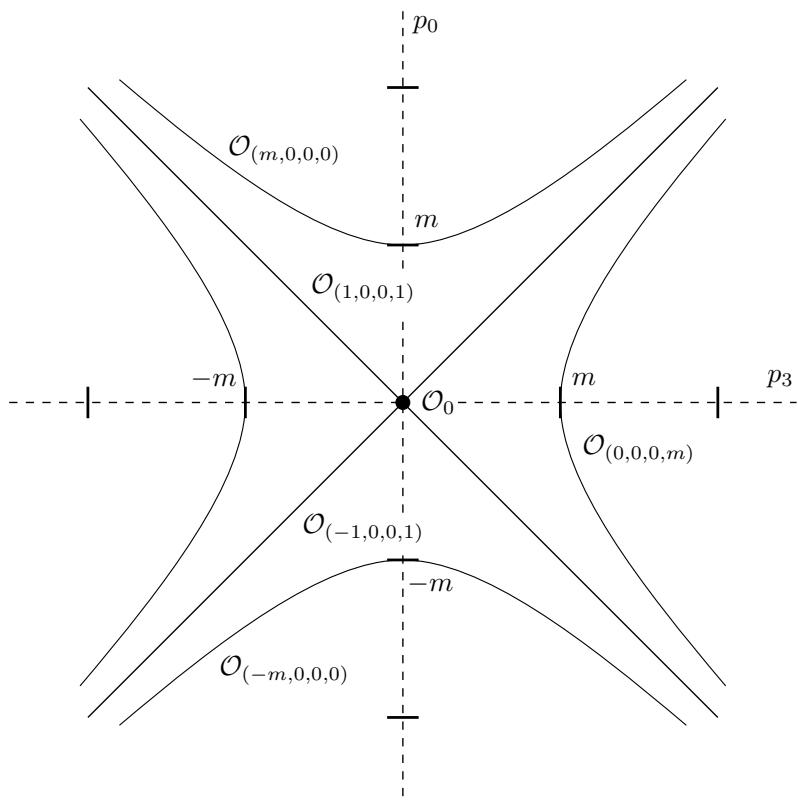
Figure 42.1: Orbits of vectors under the Lorentz group.
Unlike the Euclidean group case, here there are several diferent kinds of orbits . We’ll examine them and the corresponding stabilizer groups each in turn, and see what can be said about the associated representations.
42.3.1 Positive energy time-like orbits
Concept links · terms present in this machine draft; source roles are unverified: eigenvalue · group representation · irreducible representation
One way to get negative values of the Casimir is to take the vector and generate an orbit by acting on it with the Lorentz group. This will be the upper, positive energy, sheet of the hyperboloid of two sheets
so
The stabilizer group of is the subgroup of of elements of the form
where , so . Irreducible representations of this group are classified by the spin. For spin 0, points on the hyperboloid can be identified with positive energy solutions to a wave equation called the Klein-Gordon equation and functions on the hyperboloid both correspond to the space of all solutions of this equation and carry an irreducible representation of the Poincar´e group. This case will be studied in detail in chapters 43 and 44. We will study the case of spin in chapter , where one must use the double cover of . The Poincar´e group representation will be on functions on the orbit that take values in two copies of the spinor representation of These will correspond to solutions of a wave equation called the massive Dirac equation. For choices of higher spin representations of the stabilizer group, one can again find appropriate wave equations and construct Poincar´e group representations on their space of solutions (although additional subsidiary conditions are often needed) but we will not enter into this topic.
For the Pauli-Lubanski operator will be
and the second Casimir operator will be
The eigenvalues of are thus proportional to the eigenvalues of , the Casimir operator for the subgroup of spatial rotations. These are again given by the spin and will take the values . These eigenvalues classify representations consistently with the stabilizer group classification.
42.3.2 Negative energy time-like orbits
Concept links · terms present in this machine draft; source roles are unverified: group representation
Starting instead with the energy-momentum vector the orbit one gets is the lower, negative energy component of the hyperboloid
satisfying
Again, one has the same stabilizer group and the same constructions of wave equations of various spins and Poincar´e group representations on their solution spaces as in the positive energy case. Since negative energies lead to unstable, unphysical theories, we will see that these representations are treated diferently under quantization, corresponding physically not to particles, but to antiparticles.
42.3.3 Space-like orbits
Concept links · terms present in this machine draft; source roles are unverified: unitary representation
One can get positive values of the Casimir by considering the orbit of the vector . This is a hyperboloid of one sheet,
satisfying the equation
It is not too dificult to see that the stabilizer group of the orbit is . This is isomorphic to the group , and it has no finite dimensional unitary representations. These orbits correspond physically to “tachyons”, particles that move faster than the speed of light, and there is no known way to consistently incorporate them in a conventional theory.
42.3.4 The zero orbit
The simplest case where the Casimir is zero is the trivial case of a point This is invariant under the full Lorentz group, so the orbit is just a single point and the stabilizer group is the entire Lorentz group . For each finite dimensional representation of one gets a corresponding finite dimensional representation of the Poincar´e group, with translations acting trivially. These representations are not unitary, so not usable for our purposes. Note that these representations are not distinguished by the value of the second Casimir , which is zero for all of them.
42.3.5 Positive energy null orbits
Concept links · terms present in this machine draft; source roles are unverified: eigenvalue · Lie algebra · unitary representation · irreducible representation
One has not only for the zero-vector in momentum space, but for a three dimensional set of energy-momentum vectors, called the null-cone. the term “cone” one means that if a vector is in the space, so are all products of the vector times a positive number. Vectors are called “light-like” or “null” when they satisfy
One such vector is and the orbit of the vector under the action of the Lorentz group will be the upper half of the full null-cone, the half with energy , satisfying
It turns out that the stabilizer group of is the Euclidean group of the plane. One way to see this is to use the matrix representation 42.1 which explicitly gives the action of the Poincar´e Lie algebra on Minkowski space vectors, and note that
each act trivially on is the infinitesimal spatial rotation about the 3-axis. Defining
and calculating the commutators
we see that these three elements of the Lie algebra are a basis of a Lie subalgebra isomorphic to the Lie algebra of
Recall from section 19.1 that there are two kinds of irreducible unitary representations of :
• Representations such that the two translations act trivially. These are irreducible representations of , so one dimensional and characterized by an integer (half-integers when the Poincar´e group double cover is used).
• Infinite dimensional irreducible representations on a space of functions on a circle of radius r.
The first of these two cases corresponds to irreducible representations of the Poincar´e group labeled by an integer which is called the “helici of the representation. Given the representation, will be the eigenvalue of acting on the energy-momentum eigenspace with energy-momentum . We will in later chapters consider the cases (massless scalars, wave equation the Klein-Gordon equation), spinors, wave equation the Weyl equation), and (photons, wave equation the Maxwell equations). The second sort of representation of corresponds to representations of the Poincar´e group known as “continuous spin” representations, but these seem not to correspond to any known physical phenomena.
Calculating the components of the Pauli-Lubanski operator, one finds
Defining
the second Casimir operator is given by
which is the Casimir operator for . It takes non-zero values on the continuous spin representations, but is zero for the representations where translations act trivially. It does thus not distinguish between massless Poincar´e representations of diferent helicities.
42.3.6 Negative energy null orbits
Looking instead at the orbit of , one gets the negative energy part of the null-cone. As with the time-like hyperboloids of non-zero mass , these will correspond to antiparticles instead of particles, with the same classification as in the positive energy case.
来源与版本
正文:英文 · OCR 机器稿 · 待校对
核对状态:OCR 机器稿 · 待校对
原书 PDF · 印刷页 444、445、446、447、448、449、450、451、452、453、454、455
来源版本:2025-10-20
来源 PDF SHA-256:5a1941b2443b54d5db3d055f1e5ba390429b7a728475258017aaac87ee85a837
OCR 来源 SHA-256:77b4da6c2272b606e953ece8669bd1810946873c05ecfe49ade61de273a7678a
OCR 产物 SHA-256:77b4da6c2272b606e953ece8669bd1810946873c05ecfe49ade61de273a7678a