15.2 Hamiltonian vector fields and canonical transformations
Concept links · terms present in this machine draft; source roles are unverified: linear map · Lie algebra · Lie bracket
Our interest is not in general vector fields, but in vector fields corresponding to Hamilton’s equations for some Hamiltonian function , the case
We call such vector fields Hamiltonian vector fields, defining:
Definition (Hamiltonian vector field)
vector field on given by
for some function on is called a Hamiltonian vector field and will be denoted by . In higher dimensions, Hamiltonian vector fields will be those of the form
for some function on
The simplest non-zero Hamiltonian vector fields are those for linear function. For constants, if
then
and the map
is the isomorphism of and M of equation 14.6.
For example, taking , we have . The exponential map for this vector field satisfies
Similarly, for one has and
Quadratic functions give vector fields with components linear in the coordinates. An important example is the case of the quadratic function
which is the Hamiltonian function for a harmonic oscillator, a system that will be treated in much more detail beginning in chapter 22. The Hamiltonian vector field for this function is 2
The trajectories satisfy
and are given by
The exponential map is given by clockwise rotation through an angle
The vector field and the trajectories in the qp plane look like this
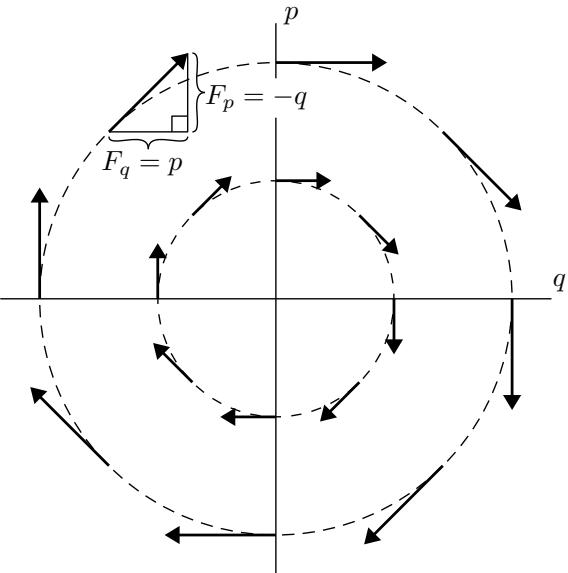
Figure 15.1: Hamiltonian vector field for a simple harmonic oscillator.
and describe a periodic motion in phase space.
The relation of vector fields to the Poisson bracket is given by (see equation 15.2)
and in particular
The definition we have given here of (equation 15.2) carries with it a choice of how to deal with a confusing sign issue. Recall that vector fields on form a Lie algebra with Lie bracket the commutator of diferential operators. A natural question is that of how this Lie algebra is related to the Lie algebra of functions on (with Lie bracket the Poisson bracket).
The Jacobi identity implies
so
This shows that the map of equation 15.2 that we defined between these Lie algebras is not quite a Lie algebra homomorphism because of the - sign in equation 15.5 (it is called a Lie algebra “antihomomorphism”). The map that is a Lie algebra homomorphism is
To keep track of the minus sign here, one needs to keep straight the diference between
• The functions on phase space are a Lie algebra, with a function acting on the function space by the adjoint action
and
• The functions provide vector fields acting on functions on , where
As a simple example, the function satisfies
so
Note that acting on functions with in this way is the Lie algebra version of the representation of the translation group on functions induced from the translation action on the position (see equations 10.1 and 10.2).
It is important to note that the Lie algebra homomorphism 15.6 from functions to vector fields is not an isomorphism, for two reasons:
• It is not injective (one-to-one), since functions and for any constant correspond to the same
• It is not surjective since not all vector fields are Hamiltonian vector fields , of the form for some . One property that a vector field must satisfy in order to possibly be a Hamiltonian vector field is
for and on . This is the Jacobi identity for , when
Digression. For a general symplectic manifold the symplectic two-form gives us an analog of Hamilton’s equations. This is the following equality of one-forms, relating a Hamiltonian function and a vector field determining time evolution of trajectories in
(here is interior product with the vector field . The Poisson bracket in this context can be defined as
Recall that a symplectic two-form is defined to be closed, satisfying the equation which is then a condition on a three-form d. Standard diferential form computations allow one to express d in terms of Poisson brackets of functions , and one finds that is the Jacobi identity for the Poisson bracket.
The theory of “prequantization” (see enlarges the phase space to a bundle with connection, where the curvature of the connection is the symplectic form . Then the problem of lack of injectivity of the Lie algebra homomorphism
is resolved by instead using the map
where is the covariant derivative with respect to the connection. For details of this, see
In our treatment of functions on phase space , we have always been taking such functions to be time-independent. M can be thought of as the space of trajectories of a classical mechanical system, with coordinates having the interpretation of initial conditions of the trajectories. The exponential maps exp give an action on the space of trajectories for the Hamiltonian function , taking the trajectory with initial conditions given by to the time-translated one with initial conditions given by . One should really interpret the formula for Hamilton’s equations
as meaning
for each
Given a Hamiltonian vector field , the maps
are known to physicists as “canonical transformations”, and to mathematicians as “symplectomorphisms”. We will not try and work out in any more detail how the exponential map behaves in general. In chapter 16 we will see what happens for an order-two homogeneous polynomial in the . In that case the vector field will take linear functions on to linear functions, thus acting on , in which case its behavior can be studied using the matrix for the linear transformation with respect to the basis elements
Digression. The exponential map exp(tX) can be defined as above on a general manifold. For a symplectic manifold , Hamiltonian vector fields will have the property that they preserve the symplectic form, in the sense that
This is because
where is the Lie derivative along
来源与版本
正文:英文 · OCR 机器稿 · 待校对
核对状态:OCR 机器稿 · 待校对
原书 PDF · 印刷页 171、172、173、174、175、176、177、178、179、180、181、182、183、184
来源版本:2025-10-20
来源 PDF SHA-256:5a1941b2443b54d5db3d055f1e5ba390429b7a728475258017aaac87ee85a837
OCR 来源 SHA-256:c4bd5d0938766c14d748148c06d1d3db5fdb93a4163ce17a632b1b7c023ee003
OCR 产物 SHA-256:c4bd5d0938766c14d748148c06d1d3db5fdb93a4163ce17a632b1b7c023ee003