19.3 Other representations of E(3)
Concept links · terms present in this machine draft; source roles are unverified: Lie algebra · Lie algebra representation · irreducible representation · group action
For the case of , besides the representations parametrized by constructed above, as in the case there are finite dimensional representations where the translation subgroup of acts trivially. Such irreducible representations are just the spin-s representations of for
E(3) has some structure not seen in the case, which can be used to construct new classes of infinite dimensional irreducible representations. This can be seen from two diferent points of view:
• There is a second Casimir operator which one can show commutes with the action, given by
• The group acts on momentum vectors by rotation, with orbit of the group action the sphere of momentum vectors of fixed energy . This is the sphere on which the Fourier transform of the wavefunctions in the representation is supported. Unlike the corresponding circle in the case, here there is a non-trivial subgroup of the rotation group which leaves a given momentum vector invariant. This is the subgroup of rotations about the axis determined by the momentum vector, and it is diferent for diferent points in momentum space.
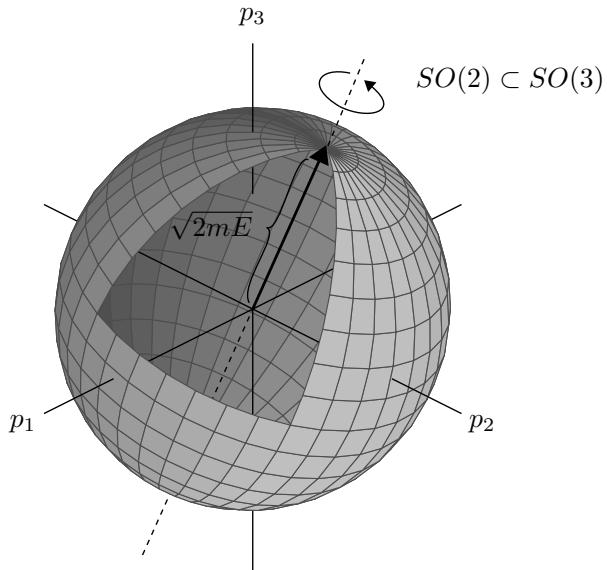
Figure 19.2: Copy of leaving a given momentum vector invariant.
For single-component wavefunctions, a straightforward computation shows that the second Casimir operator acts as zero. By introducing wavefunctions with several components, together with an action of that mixes the components, it turns out that one can get new irreducible representations, with a non-zero value of the second Casimir corresponding to a non-trivial weight of the action of the of rotations about the momentum vector.
Such multiple-component wavefunctions can be constructed as representations of by taking the tensor product of our irreducible representation on wavefunctions of energy E (call this and the finite dimensional irreducible representation
The Lie algebra representation operators for the translation part of act as momentum operators on and as 0 on . For the part of 2 we get angular momentum operators that can be written as
where acts on and acts on
This tensor product representation will not be irreducible, but its irreducible components can be found by taking the eigenspaces of the second Casimir operator, which will now be
We will not work out the details of this here (although details can be found in chapter 34 for the case , where the half-integrality corresponds to replacing by its double cover . What happens is that the tensor product breaks up into irreducibles as
where is an integer taking values from that is called the “helicity”. is the subspace of the tensor product on which the first Casimir takes the value 2m , and the second Casimir J · P takes the value , where . The physical interpretation of the helicity is that it is the component of angular momentum along the axis given by the momentum vector. The helicity can also be thought of as the weight of the action of the subgroup of corresponding to rotations about the axis of the momentum vector.
Choosing and , the representations on (which we have constructed using some s such that ) give all possible irreducible representations of . The representation spaces have a physical interpretation as the state space for a free quantum particle of energy which carries an “internal” quantized angular momentum about its direction of motion, given by the helicity.
来源与版本
正文:英文 · OCR 机器稿 · 待校对
核对状态:OCR 机器稿 · 待校对
原书 PDF · 印刷页 210、211、212、213、214、215、216、217、218、219、220
来源版本:2025-10-20
来源 PDF SHA-256:5a1941b2443b54d5db3d055f1e5ba390429b7a728475258017aaac87ee85a837
OCR 来源 SHA-256:96747283728210a94caf040995427342b95d9623aec43d018ba9712da0c11296
OCR 产物 SHA-256:96747283728210a94caf040995427342b95d9623aec43d018ba9712da0c11296