29.2 Cliford algebras and geometry
Concept links · terms present in this machine draft; source roles are unverified: vector space
As defined by generators in the last chapter, Cliford algebras have no obvious geometrical significance. It turns out however that they are powerful tools in the study of the geometry of linear spaces with an inner product, including especially the study of linear transformations that preserve the inner product, .e., rotations. To see the relation between Cliford algebras and geometry, consider first the positive definite case . To an arbitrary vector
we associate the Cliford algebra element where is the map
Using the Cliford algebra relations for the , given two vectors , the product of their associated Cliford algebra elements satisfies
where is the symmetric bilinear form on corresponding to the standard inner product of vectors. Note that taking one has
The Cliford algebra thus contains as the subspace of linear combinations of the generators It can be thought of as a sort of enhancement of the vector space that encodes information about the inner product, and it will sometimes be written . In this larger structure vectors can be multiplied as well as added, with the multiplication determined by the inner product and given by equation 29.2. Note that diferent people use diferent conventions, with
another common choice. One also sees variants without the factor of 2.
For n dimensional vector spaces over , we have seen that for any nondegenerate symmetric bilinear form a basis can be found such that has the standard form
As a result, up to isomorphism, there is just one complex Cliford algebra in dimension the one we defined as . For n dimensional vector spaces over with a non-degenerate symmetric bilinear form of type r, such that , the corresponding Cliford algebras are the ones defined in terms of generators in section 28.2.
In special relativity, space-time is a real four dimensional vector space with an indefinite inner product corresponding to (depending on one’s choice of convention) either the case or the case . The group of linear transformations preserving this inner product is called the Lorentz group, and its orientation preserving component is written as or depending on the choice of convention. In later chapters we will consider what happens to quantum mechanics in the relativistic case, and there encounter the corresponding Cliford algebras or . The generators of such a Cliford algebra are well known in the subject as the “Dirac matrices”.
For now though, we will restrict attention to the positive definite case, so just will be considering and seeing how it is used to study the group of n dimensional rotations in
29.2.1 Rotations as iterated orthogonal reflections
Concept links · terms present in this machine draft; source roles are unverified: linear map
We’ll consider two diferent ways of seeing the relationship between the Cliford algebra and the group of rotations in . The first is based upon the geometrical fact (known as the Cartan-Dieudonn´e theorem) that one can get any rotation by doing at most n orthogonal reflections in diferent hyperplanes. Orthogonal reflection in the hyperplane perpendicular to a vector takes a vector to the vector
something that can easily be seen from the following picture
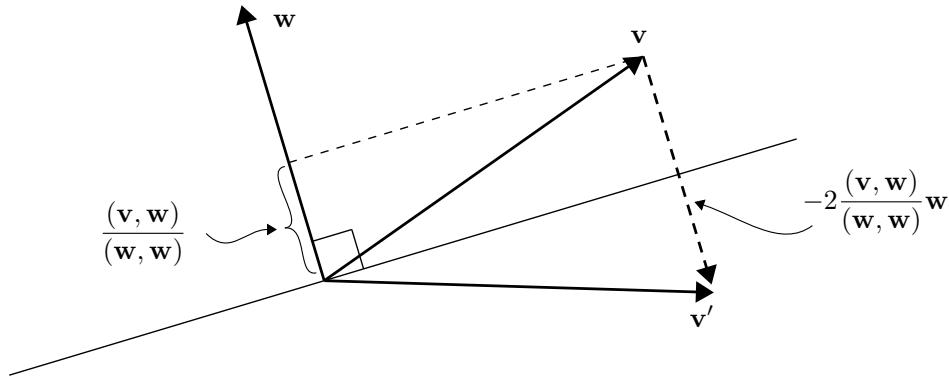
Figure 29.1: Orthogonal reflection in the hyperplane perpendicular to
From now on we identify vectors , with the corresponding Cliford algebra elements by the map of equation 29.1. The linear transformation given by reflection in is
Since
we have (for non-zero vectors )
and the reflection transformation is just conjugation by / times a minus sign
Identifying vectors with Cliford algebra elements, the orthogonal transformation that is the result of one reflection is given by a conjugation (with a minus sign). These reflections lie in the group , but not in the subgroup since they change orientation. The result of two reflections in hyperplanes orthogonal to will be a conjugation by
This will be a rotation preserving the orientation, so of determinant one and in the group
This construction not only gives an eficient way of representing rotations (as conjugations in the Cliford algebra), but it also provides a construction of the group in arbitrary dimension . One can define:
Definition
The action of on vectors will be given by conjugation
and this will correspond to a rotation of the vector . This construction generalizes to arbitrary n the one we gave in chapter 6 of in terms of unit length elements of the quaternion algebra . One can see here the characteristic fact that there are two elements of the group giving the same rotation in by noticing that changing the sign of the Cliford algebra element does not change the conjugation action, where signs cancel.
29.2.2 The Lie algebra of the rotation group and quadratic elements of the Cliford algebra
Concept links · terms present in this machine draft; source roles are unverified: Lie algebra
For a second approach to understanding rotations in arbitrary dimension, one can use the fact that these are generated by taking products of rotations in the coordinate planes. A rotation by an angle in the coordinate plane will be given by
where is an n by matrix with only two non-zero entries: entry −1 and entry +1 (see equation 5.2.1). Restricting attention to the plane, acts as the standard rotation matrix in the plane
In the case we saw that there were three of these matrices
providing a basis of the Lie algebra . In dimensions there will be of them, providing a basis of the Lie algebra
Just as in the case of where unit length quaternions were used, in dimension we can use elements of the Cliford algebra to get these same rotation transformations, but as conjugations in the Cliford algebra. To see how this works, consider the quadratic Cliford algebra element for and notice that
so one has
Conjugating a vector in the plane by this, one can show that
which is a rotation by in the plane. Such a conjugation will also leave invariant the for . Thus one has
and, taking the derivative at , the infinitesimal version
Note that these relations are closely analogous to what happens in the symplectic case, where the symplectic group acts on linear combinations of the by conjugation by the exponential of an operator quadratic in the We will examine this analogy in greater detail in chapter 31.
One can also see that, just as in our earlier calculations in three dimensions, one gets a double cover of the group of rotations, with here the elements of the Cliford algebra giving a double cover of the group of rotations in the plane (as goes from 0 to 2). General elements of the spin group can be constructed by multiplying these for diferent angles in diferent coordinate planes. The Lie algebra spin(n) can be identified with the Lie algebra by
Yet another way to see this would be to compute the commutators of the for diferent values of and show that they satisfy the same commutation relations as the corresponding matrices
Recall that in the bosonic case we found that quadratic combinations of the (or of the gave operators satisfying the commutation relations of the Lie algebra . This is the Lie algebra of the group ), the group preserving the non-degenerate antisymmetric bilinear form on the phase space . The fermionic case is precisely analogous, with the role of the antisymmetric bilinear form replaced by the symmetric bilinear form and the Lie algebra replaced by
In the bosonic case the linear functions of the satisfied the commutation relations of another Lie algebra, the Heisenberg algebra, but in the fermionic case this is not true for the . In chapter 30 we will see that a notion of a “Lie superalgebra” can be defined that restores the parallelism.
来源与版本
正文:英文 · OCR 机器稿 · 待校对
核对状态:OCR 机器稿 · 待校对
原书 PDF · 印刷页 318、319、320、321、322、323、324、325
来源版本:2025-10-20
来源 PDF SHA-256:5a1941b2443b54d5db3d055f1e5ba390429b7a728475258017aaac87ee85a837
OCR 来源 SHA-256:255e6de176b891a110e84138f84ce4224218312b2f275d3d598b59b1d077e160
OCR 产物 SHA-256:255e6de176b891a110e84138f84ce4224218312b2f275d3d598b59b1d077e160