19.1 The quantum free particle and representations of E(2)
Concept links · terms present in this machine draft; source roles are unverified: eigenvalue · Lie algebra · Lie algebra representation · unitary representation · irreducible representation · Lie bracket
We’ll begin for simplicity with the case of two spatial dimensions. Recall from chapter 18 that the Euclidean group is a subgroup of the Jacobi group . For the case , the translations are a subgroup of the Heisenberg group (translations in and the rotations are a subgroup (simultaneous rotations of and . The Lie algebra of is a sub-Lie algebra of the Lie algebra of polynomials in of degree at most two.
More specifically, a basis for the Lie algebra of is given by the functions
on the phase space , where is a basis for the Lie algebra of rotations, a basis for the Lie algebra of translations. The non-zero Lie bracket relations are given by the Poisson brackets
which are the infinitesimal version of the rotation action of on . There is an isomorphism of this Lie algebra with a matrix Lie algebra of 3 by 3 matrices given by
Since we have realized the Lie algebra of as a sub-Lie algebra of the Jacobi Lie algebra , quantization via the Schr¨odinger representation provides a unitary Lie algebra representation on the state space of functions of the position variables . This will be given by the operators
and
The Hamiltonian operator for the free particle is
and solutions to the Schr¨odinger equation can be found by solving the eigenvalue equation
The operators commute with and so provide a representation of the Lie algebra of on the space of wavefunctions of energy
This construction of irreducible representations of is similar in spirit to the construction of irreducible representations of in section . There the Casimir operator commuted with the action, and gave a diferential operator on functions on the sphere whose eigenfunctions were spaces of dimension with eigenvalue , for l non-negative and integral. For the quadratic function Poisson commutes with . After quantization,
is a second-order diferential operator which commutes with This operator has infinite dimensional eigenspaces that each carry an irreducible representation of ). They are characterized by a non-negative eigenvalue that has physical interpretation as 2mE where are the mass and energy of a free quantum particle moving in two spatial dimensions.
From our discussion of the free particle in chapter 11 we see that, in momentum space, solutions of the Schr¨odinger equation are given by
and are parametrized by distributions
on . These will have well-defined momentum when
The position space wavefunctions can be recovered from the Fourier inversion formula
Since, in the momentum space representation, the momentum operator is the multiplication operator
an eigenfunction for the Hamiltonian with eigenvalue E will satisfy
can only be non-zero if , so free particle solutions of energy E will thus be parametrized by distributions that are supported on the circle
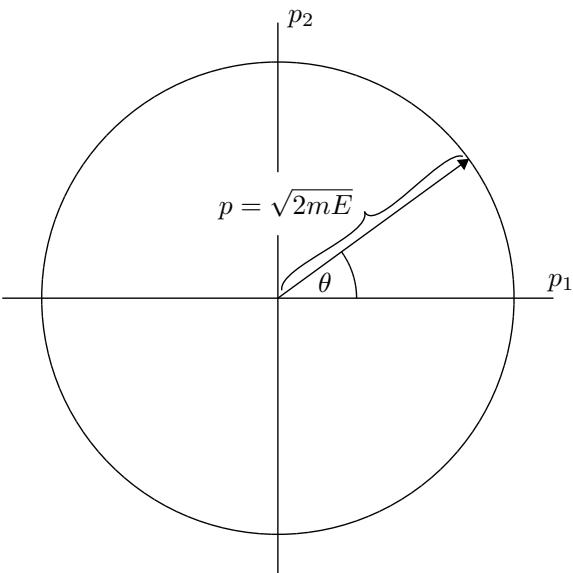
Figure 19.1: Parametrizing free particle solutions of Schr¨odinger’s equation via distributions supported on a circle in momentum space.
Going to polar coordinates , such solutions are given by distributions of the form
depending on two variables . To put this delta-function in a more useful form, recall the discussion leading to equation 11.9 and note that for one has the linear approximation
so one has the equality of distributions
In the one dimensional case (see equation 11.10) we found that the space of solutions of energy E was parametrized by two complex numbers, corresponding to the two possible momenta . In this two dimensional case, the space of such solutions will be infinite dimensional, parametrized by distributions on the circle.
It is this space of distributions on the circle of radius that will provide an infinite dimensional representation of the group , one that turns out to be irreducible, although we will not show that here. The position space wavefunction corresponding to will be
Functions with simple behavior in will correspond to wavefunctions with more complicated behavior in position space. For instance, taking one finds that the wavefunction along the direction is given by
where is the n’th Bessel function.
Equations 19.1 and 19.2 give the representation of the Lie algebra of on wavefunctions . The representation of this Lie algebra on the is given by the Fourier transform, and we’ll denote this by . Using the formula for the Fourier transform we find that
are multiplication operators and, taking the Fourier transform of 19.2 gives the diferentiation operator
(use integration by parts to show and thus the first equality, then the chain rule for functions for the second).
This construction of a representation of starting with the Schr¨odinger representation gives the same result as starting with the action of on configuration space, and taking the induced action on functions on (the wavefunctions). To see this, note that has elements which can be written as a product or, in terms of matrices
The group has a unitary representation
on the position space wavefunctions , given by the induced action on functions from the action of on position space
This representation of is the same as the exponentiated version of the Schr¨odinger representation of the Jacobi Lie algebra , restricted to the Lie algebra of . This can be seen by considering the action of translations as the exponential of the Lie algebra representation operators
and the action of rotations as the exponential of the
One also has a Fourier-transformed version of this representation, with translations now acting by multiplication operators on the
and rotations acting by rotating the circle in momentum space
Although we won’t prove it here, the representations constructed in this way provide essentially all the unitary irreducible representations of , parametrized by a real number . The only other ones are those on which the translations act trivially, corresponding to , with acting as an irreducible representation. We have seen that such representations are one dimensional, and characterized by an integer, the weight. We thus get another class of irreducible representations, labeled by an integer, but they are just one dimensional representations on .
来源与版本
正文:英文 · OCR 机器稿 · 待校对
核对状态:OCR 机器稿 · 待校对
原书 PDF · 印刷页 210、211、212、213、214、215、216、217、218、219、220
来源版本:2025-10-20
来源 PDF SHA-256:5a1941b2443b54d5db3d055f1e5ba390429b7a728475258017aaac87ee85a837
OCR 来源 SHA-256:96747283728210a94caf040995427342b95d9623aec43d018ba9712da0c11296
OCR 产物 SHA-256:96747283728210a94caf040995427342b95d9623aec43d018ba9712da0c11296