27.2 Multiple degrees of freedom
Concept links · terms present in this machine draft; source roles are unverified: eigenvalue · Lie algebra · Lie algebra representation · Pauli matrices
For the case of degrees of freedom, one has this variant of the canonical commutation relations (CCR) amongst the bosonic annihilation and creation operators and :
Definition (Canonical anticommutation relations)
A set of 2d operators
is said to satisfy the canonical anticommutation relations when one has
In this case one may choose as the state space the tensor product of N copies of the single fermionic oscillator state space
The dimension of will be . On this space an explicit construction of the operators and in terms of Pauli matrices is
The factors of are there as one possible way to ensure that
are satisfied for since then one will get in the tensor product factors
While this sort of tensor product construction is useful for discussing the physics of multiple qubits, in general it is easier to not work with large tensor products, and the Cliford algebra formalism we will describe in chapter 28 avoids this.
The number operators will be
These will commute with each other, so can be simultaneously diagonalized, with eigenvalues 1. One can take as a basis of the states
which are the natural basis states for given by choices of either |0⟩ or |1⟩.
As an example, for the case the picture shows the pattern of states and their energy levels for the bosonic and fermionic cases. In the bosonic case the lowest energy state is at positive energy and there are an infinite number of states of ever increasing energy. In the fermionic case the lowest energy state is at negative energy, with the pattern of energy eigenvalues of the finite number of states symmetric about the zero energy level.
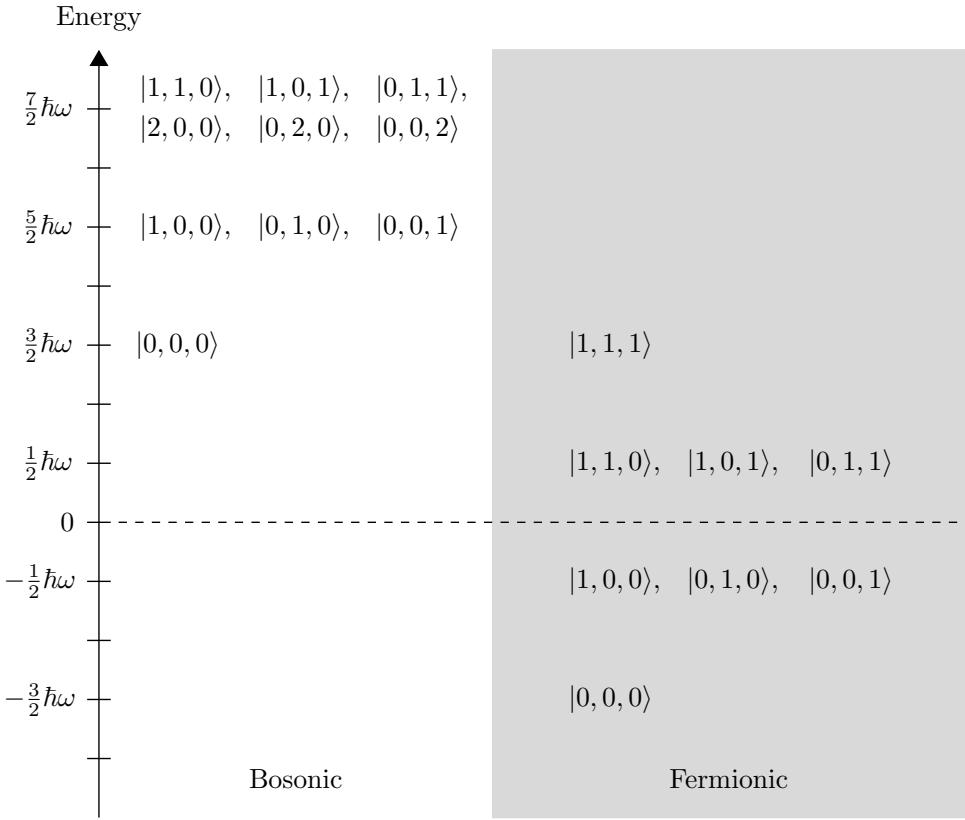
Figure 27.1: oscillator energy eigenstates.
Just as in the bosonic case, we can consider quadratic combinations of creation and annihilation operators of the form
and we have
Theorem 27.1
For a d by complex matrix one has
So
is a Lie algebra representation of on
One also has (for column vectors with components
Proof. The proof is similar to that of 25.1, except besides the relation
we also use the relation
For example
The Hamiltonian is
which (up to the constant that doesn’t contribute to commutation relations) is just for the case . Since this commutes with all other d by matrices, we have
for all , so these are symmetries and we have a representation of the Lie algebra on each energy eigenspace. Only for (A a skew-adjoint matrix) will the representation turn out to be unitary.
来源与版本
正文:英文 · OCR 机器稿 · 待校对
核对状态:OCR 机器稿 · 待校对
原书 PDF · 印刷页 305、306、307、308、309、310
来源版本:2025-10-20
来源 PDF SHA-256:5a1941b2443b54d5db3d055f1e5ba390429b7a728475258017aaac87ee85a837
OCR 来源 SHA-256:c5f60a28e528298c225022ad97788868b73f69d85fe61d2f4d5175af6c239f1f
OCR 产物 SHA-256:c5f60a28e528298c225022ad97788868b73f69d85fe61d2f4d5175af6c239f1f