In physics and some areas of engineering it has become common to make use of certain ‘functions’ such as the Dirac delta function , having the property
for all continuous functions . If we set to be a continuous function that is everywhere zero except on a small interval on which , it follows that for all . However, setting implies , so we must assign an infinite value to
As it stands this really won’t do, since the -function vanishes a.e. and should therefore be assigned Lebesgue integral zero. Our aim in this chapter is to give a rigorous definition of such ‘generalized functions’, which avoids these contradictions.
In an intuitive sense we might think of the Dirac delta function as being the ‘limit’ of a sequence of functions (see Fig. 12.1) such as
or of Gaussian functions
Lebesgue’s dominated convergence theorem does not apply to these sequences, yet the limi of the integrals is clearly 1, and for any continuous function it is not difficult to show that
However, we will not attempt to define Dirac-like functions as limiting functions in some sense. Rather, following Laurent Schwartz, we define them as continuous linear functionals on a suitably defined space of regular test functions. This method is called the theory of distributions [1–6].
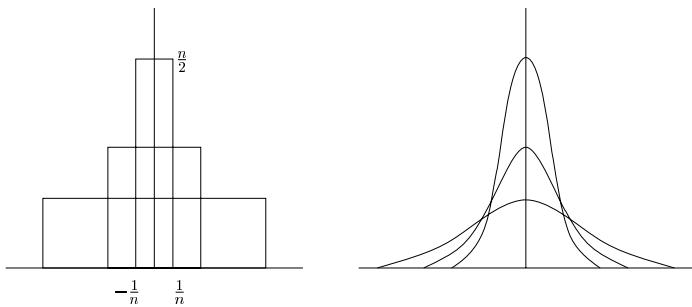 Figure 12.1 Dirac delta function as a limit of functions
Contents
- 12.1 Test functions and distributions
- 12.2 Operations on distributions
- 12.3 Fourier transforms
- 12.4 Green’s functions
Concept index
Terms by section. Links lead to the brown underlined definitions in the Chinese reading text.
12.1 Test functions and distributions
- support支集
- compact support紧支集
- infinitely differentiable无穷次可微
- test function space试验函数空间
- distribution of order有限阶分布
- distribution分布
- locally integrable局部可积
- density密度
- regular distribution正则分布
- singular distribution奇异分布
- weak convergence弱收敛
12.2 Operations on distributions
12.3 Fourier transforms
- Fourier transform傅里叶变换
- inverse Fourier transform傅里叶逆变换
- rapidly decreasing function快速下降函数
- tempered distribution缓增分布