8.3 Representations of SO(3) and spherical harmonics
Concept links · terms present in this machine draft; source roles are unverified: eigenvalue · Lie algebra · Lie algebra representation · unitary representation · irreducible representation · complexification
We would like to now use the classification and construction of representations of to study the representations of the closely related group . For any representation of , we can use the double covering homomorphism to get a representation
of . It can be shown that if is irreducible, will be too, so we must have , one of the irreducible representations of found in the last section. Using the fact that , we see that
From knowing that the weights of , we know that
which will only be true for n even, not for n odd. Since the Lie algebra of is isomorphic to the Lie algebra of , the same Lie algebra argument using raising and lowering operators as in the last section also applies. The irreducible representations of will be for , of dimension and satisfying
Just like in the case of , we can explicitly construct these representations using functions on a space with an action. The obvious space to choose is with the standard action. The induced representation is as usual
and by the same argument as in the case, once one has chosen a basis, is an orthogonal 3 by 3 matrix that acts on the coordinates (a basis of the dual by
Taking the derivative, the Lie algebra representation on functions is given by
where . Recall that a basis for so(3) is given by the antisymmetric matrices
which satisfy the commutation relations
Digression. A note on conventions
We’re using the notation for the real basis of the Lie algebra For a unitary representation the will be skew-adjoint linear operators. For consistency with the physics literature, we’ll use the notation for the self-adjoint version of the linear operator corresponding to in this representation on functions. The satisfy the commutation relations
We’ll also use elements of the complexified Lie algebra to create raising and lowering operators
As with the case, we won’t include a factor of ℏ as is usual in physics (the usual convention is , since for considerations of the action of the rotation group it would cancel out (physicists define rotations using The factor of ℏ is only of significance when is expressed in terms of the momentum operator, a topic discussed in chapter 19.
In the SU(2) case, the had half-integral eigenvalues, with the eigenvalues of the integral weights of the representation. Here the will have integer eigenvalues, the weights will be the eigenvalues of , which will be even integers.
Computing we find
so
and similar calculations give
The space of all functions on is much too big: it will give us an infinity of copies of each finite dimensional representation that we want. Notice that when acts on , it leaves the distance to the origin invariant. If we work in spherical coordinates (see picture)
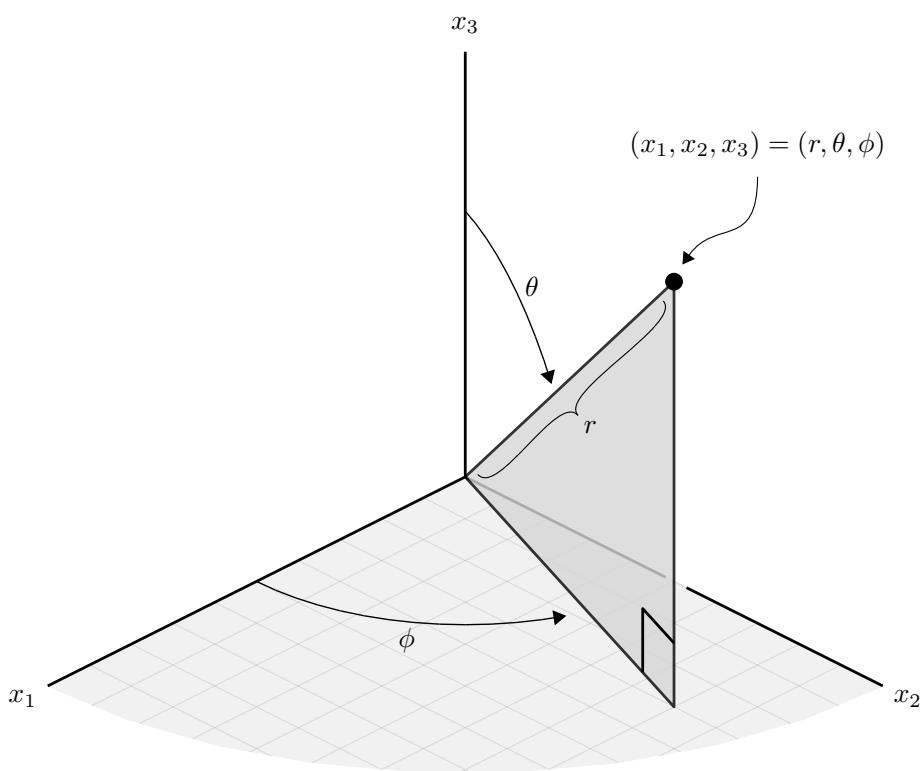
Figure 8.2: Spherical coordinates.
we will have
Acting on will leave r invariant, only acting non-trivially on . It turns out that we can cut down the space of functions to something that will only contain one copy of the representation we want in various ways. One way to do this is to restrict our functions to the unit sphere, .e., look at functions . We will see that the representations we are looking for can be found in simple trigonometric functions of these two angular variables.
We can construct our irreducible representations by explicitly constructing a function we will call that will be a highest weight vector of weight . The weight condition and the highest weight condition give two diferential equations for
These will turn out to have a unique solution (up to scalars).
We first need to change coordinates from rectangular to spherical in our expressions for . Using the chain rule to compute expressions like
we find
so
This is an orthogonal matrix, so can be inverted by taking its transpose, to get
So we finally have
and
Now that we have expressions for the action of the Lie algebra on functions in spherical coordinates, our two diferential equations saying our function is of weight and in the highest weight space are
and
The first of these tells us that
for some function , and using the second we get
with solution
for an arbitrary constant . Finally
This is a function on the sphere, which is also a highest weight vector in a dimensional irreducible representation of . Repeatedly applying the lowering operator gives vectors spanning the rest of the weight spaces, the functions
for
The functions are called “spherical harmonics”, and they span the space of complex functions on the sphere in much the same way that the span the space of complex-valued functions on the circle. Unlike the case of polynomials on , for functions on the sphere, one gets finite numbers by integrating such functions over the sphere. So an inner product on these representations for which they are unitary can be defined by simply setting
We will not try and show this here, but for the allowable values of the are mutually orthogonal with respect to this inner product.
One can derive various general formulas for the in terms of Legendre polynomials, but here we’ll just compute the first few examples, with the proper constants that give them norm 1 with respect to the chosen inner product.
• For the representation
• For the representation
(one can easily see that these have the correct eigenvalues for
• For the = 2 representation one has
We will see in chapter 21 that these functions of the angular variables in spherical coordinates are exactly the functions that give the angular dependence of wavefunctions for the physical system of a particle in a spherically symmetric potential. In such a case the symmetry of the system implies that the state space (the wavefunctions) will provide a unitary representation of , and the action of the Hamiltonian operator will commute with the action of the operators . As a result, all of the states in an irreducible representation component of will have the same energy. States are thus organized into “orbitals”, with singlet states called orbitals , triplet states called orbitals ), multiplicity 5 states called orbitals , etc.
来源与版本
正文:英文 · OCR 机器稿 · 待校对
核对状态:OCR 机器稿 · 待校对
原书 PDF · 印刷页 89、90、91、92、93、94、95、96、97、98、99、100、101、102、103、104、105、106、107、108
来源版本:2025-10-20
来源 PDF SHA-256:5a1941b2443b54d5db3d055f1e5ba390429b7a728475258017aaac87ee85a837
OCR 来源 SHA-256:f30e5e19104ce525fa7316f25353a05960c606085ccb5d251e1897c8bfa8c58c
OCR 产物 SHA-256:f30e5e19104ce525fa7316f25353a05960c606085ccb5d251e1897c8bfa8c58c