6.2 Spin groups in three and four dimensions
Concept links · terms present in this machine draft; source roles are unverified: orthogonal group · Lie algebra · Lie group · group homomorphism
A subtle and remarkable property of the orthogonal groups is that they come with an associated group, called , with every element of corresponding to two distinct elements of . There is a surjective group homomorphism
with the inverse image of each element of given by two distinct elements of
Digression. The topological reason for this is that, the fundamental group of is non-trivial, with (in particular there is a non-contractible loop in , contractible if you go around it twice). is topologically the simply-connected double cover of , and the covering map can be chosen to be a group homomorphism.
is a Lie group of the same dimension as , with an isomorphic tangent space at the identity, so the Lie algebras of the two groups are isomorphic:
In chapter 29 we will explicitly construct the groups for any but here we will only do this for and , using methods specific to these two cases. In the cases (where , the 2 by 2 norm-preserving quaternionic matrices) and (where special methods can be used to identify with other matrix groups. For the group will be a matrix group, but distinct from other classes of such groups.
Given such a construction of , we also need to explicitly construct the homomorphism , and show that its derivative is an isomorphism of Lie algebras. We will see that the simplest construction of the spin groups here uses the group of unit-length quaternions, with and . By identifying quaternions and pairs of complex numbers, we can show that and thus work with these spin groups as either 2 by 2 complex matrices (for ), or pairs of such matrices (for .
6.2.1 Quaternions
Concept links · terms present in this machine draft; source roles are unverified: vector space · Lie group
The quaternions are a number system (denoted by ) generalizing the complex number system, with elements that can be written as
with , , satisfying
and a conjugation operation that takes
This operation satisfies (for
As a vector space over , is isomorphic with . The length-squared function on this can be written in terms of quaternions as
and is multiplicative since
Using
one has a formula for the inverse of a quaternion
The length one quaternions thus form a group under multiplication, called . There are also Lie groups called for larger values of consisting of invertible matrices with quaternionic entries that act on quaternionic vectors preserving the quaternionic length-squared, but these play no significant role in quantum mechanics so we won’t study them further. can be identified with the three dimensional sphere since the length one condition on is
the equation of the unit sphere
6.2.2 Rotations and spin groups in four dimensions
Concept links · terms present in this machine draft; source roles are unverified: linear map · Lie group
Pairs of unit quaternions give the product group . An element of this group acts on by left and right quaternionic multiplication
This action preserves lengths of vectors and is linear in so it must correspond to an element of the group . One can easily see that pairs and give the same linear transformation of , so the same element of and show that is the group , with the two elements and identified. The name is given to the Lie group that “double covers” in this manner, with the covering map
6.2.3 Rotations and spin groups in three dimensions
Concept links · terms present in this machine draft; source roles are unverified: vector space · linear map · Lie algebra · U(1) · Lie bracket
Later on we’ll encounter and again, but for now we’re interested in the subgroup that only acts non-trivially on 3 of the dimensions, and double covers not but . To find this, consider the subgroup of consisting of pairs of the form (a subgroup isomorphic to , since elements correspond to a single unit length quaternion ). This subgroup acts on quaternions by conjugation
an action which is trivial on the real quaternions (since . It preserves and acts nontrivially on the space of “pure imaginary” quaternions of the form
which can be identified with the vector space . An element acts on as
This is a linear action, preserving the length |⃗v|, so it corresponds to an element of . We thus have a map (which can easily be checked to be a homomorphism)
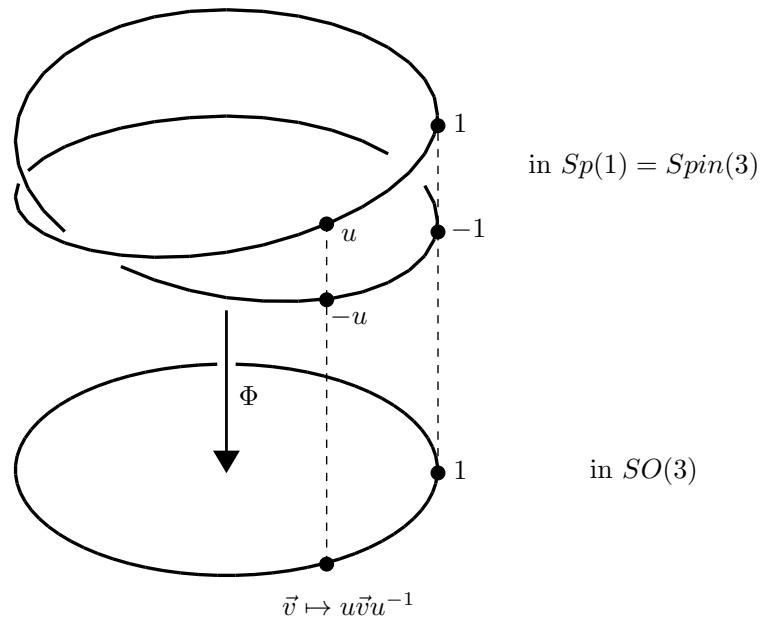
Figure 6.1: Double cover
Both u and − act in the same way on so we have two elements in corresponding to the same element in SO(3). One can show that is a surjective map (any element of SO(3) is of something), so it is what is called a “covering” map, specifically a two-fold cover. It makes a double cover of , and we give this group the name . This also allows us to characterize more simply as a geometrical space. It is with opposite points on the three-sphere identified. This space is known as , real projective 3-space, which can also be thought of as the space of lines through the origin in (each such line intersects in two opposite points).
Digression. The covering map is an example of a topologically non-trivial cover. Topologically, it is not true that . is a connected space, not two disconnected pieces. This topological non-triviality implies that globally there is no possible homomorphism going in the opposite direction from . This can be done locally, picking a local patch in and taking the inverse of to a local patch in , but this won’t work if we try and extend it globally to all of
The identification allowed us to represent elements of the unit circle group as exponentials , where was in the Lie algebra of U(1). behaves in much the same way, with the Lie algebra sp(1) now the space of all pure imaginary quaternions, which can be identified with by
Unlike the case, there’s a non-trivial Lie bracket, the commutator of quaternions.
Elements of the group are given by exponentiating such Lie algebra elements, which we will write in the form
where and is a purely imaginary quaternion of unit length. Since
the exponential can be expanded to show that
Taking as a parameter, the give paths in going through the identity at , with velocity vector ⃗w since
We can explicitly evaluate the homomorphism on such elements , with the result that takes to a rotation by an angle around the axis w:
Theorem 6.1.
Proof
First consider the special case of rotations about the 3-axis.
and
so is the rotation that takes v (identified with the quaternion to
This is the orthogonal transformation of given by
The same calculation can readily be done for the case of , then use the Euler angle parametrization of equation 6.1 to show that a general can be written as a product of the cases already worked out. □
Notice that as goes from 0 to traces out a circle in . The homomorphism takes this to a circle in , one that gets traced out twice as goes from 0 to , explicitly showing the nature of the double covering above that particular circle in .
The derivative of the map will be a Lie algebra homomorphism, a linear map
It takes the Lie algebra of pure imaginary quaternions to the Lie algebra so(3) of 3 by 3 antisymmetric real matrices. One can compute it easily on basis vectors, using for instance equation 6.2 above to find for the case k
Repeating this on other basis vectors one finds that
Thus is an isomorphism of and so(3) identifying the bases
Note that it is the that satisfy simple commutation relations
6.2.4 The spin group and SU(2)
Concept links · terms present in this machine draft; source roles are unverified: vector space · Lie algebra · Pauli matrices · Lie group · complexification
Instead of doing calculations using quaternions with their non-commutativity and special multiplication laws, it is more conventional to choose an isomorphism between quaternions and a space of 2 by 2 complex matrices, and work with matrix multiplication and complex numbers. The Pauli matrices can be used to give such an isomorphism, taking
The correspondence between H and 2 by 2 complex matrices is then given by
Since
we see that the length-squared function on quaternions corresponds to the determinant function on 2 by 2 complex matrices. Taking , so of length one, the corresponding complex matrix is in
Under this identification of H with 2 by 2 complex matrices, we have an identification of Lie algebras sp between pure imaginary quaternions and skew-Hermitian trace-zero 2 by 2 complex matrices
The basis of gets identified with a basis for the Lie algebra which written in terms of the Pauli matrices is
with the satisfying the commutation relations
which are precisely the same commutation relations as for so(3)
We now have three isomorphic Lie algebras , with elements that get identified as follows
This isomorphism identifies basis vectors by
etc. The first of these identifications comes from the way we chose to identify H with 2 by 2 complex matrices. The second identification is , the derivative at the identity of the covering map .
On each of these isomorphic Lie algebras we have adjoint Lie group (Ad) and Lie algebra representations. is given by conjugation with the corresponding group elements in and . ad is given by taking commutators in the respective Lie algebras of pure imaginary quaternions, skew-Hermitian trace-zero 2 by 2 complex matrices and 3 by 3 real antisymmetric matrices.
Note that these three Lie algebras are all three dimensional real vector spaces, so these are real representations. To get a complex representation, take complex linear combinations of elements. This is less confusing in the case of than for since taking complex linear combinations of skew-Hermitian trace-zero 2 by 2 complex matrices gives all trace-zero 2 by 2 matrices (the Lie algebra ).
In addition, recall that there is a fourth isomorphic version of this representation, the representation of on column vectors. This is also a real representation, but can straightforwardly be complexified. Since and are isomorphic Lie algebras, their complexifications so and will also be isomorphic.
In terms of 2 by 2 complex matrices, Lie algebra elements can be exponentiated to get group elements in and define
Transposing the argument of theorem 6.1 from H to complex matrices, one finds that, identifying
one has
with acting by conjugation, taking
Note that in changing from the quaternionic to complex case, we are treating the factor of 2 diferently, since in the future we will want to use to perform rotations by an angle . In terms of the identification , we have
Recall that any matrix can be written in the form
with arbitrary complex numbers satisfying . A somewhat unenlightening formula for the map in terms of such explicit matrices is given by
See [83], page 123-4, for a derivation.
来源与版本
正文:英文 · OCR 机器稿 · 待校对
核对状态:OCR 机器稿 · 待校对
原书 PDF · 印刷页 62、63、64、65、66、67、68、69、70、71、72、73、74
来源版本:2025-10-20
来源 PDF SHA-256:5a1941b2443b54d5db3d055f1e5ba390429b7a728475258017aaac87ee85a837
OCR 来源 SHA-256:9523b4fdcb950eebc22282c613f6a0d19c5f46af4d841268eb20e4448e54cea8
OCR 产物 SHA-256:9523b4fdcb950eebc22282c613f6a0d19c5f46af4d841268eb20e4448e54cea8