8.1 Representations of SU(2) : classification
8.1.1 Weight decomposition
Concept links · terms present in this machine draft; source roles are unverified: eigenvalue · irreducible representation · Pauli matrices
If we make a choice of a , then given any representation of of dimension , we get a representation of by restriction to the subgroup. Since we know the classification of irreducibles of we know that
for some , where denotes the one dimensional representation of corresponding to the integer (theorem 2.3). These are called the of the representation . They are exactly the same thing discussed in chapter 2 as “charges”, but here we’ll favor the mathematician’s terminology since the here occurs in a context far removed from that of electromagnetism and its electric charges.
Since our standard choice of coordinates (the Pauli matrices) picks out the z-direction and diagonalizes the action of the subgroup corresponding to rotation about this axis, this is the subgroup we will choose to define the weights of the representation . This is the subgroup of elements of of the form
Our decomposition of an representation into irreducible representations of this subgroup equivalently means that we can choose a basis of so that
An important property of the set of integers is the following:
Theorem
is in the set , so
Proof
Recall that if we diagonalize a unitary matrix, the diagonal entries are the eigenvalues, but their order is undetermined: acting by permutations on these eigenvalues we get diferent diagonalizations of the same matrix. In the case of the matrix
has the property that conjugation by it permutes the diagonal elements, in particular
So
and we see that gives a change of basis of such that the representation matrices on the subgroup are as before, with . Changing in the representation matrices is equivalent to changing the sign of the weights . The elements of the set are independent of the basis, so the additional symmetry under sign change implies that for each non-zero element in the set there is another one with the opposite sign. □
Looking at our three examples so far, we see that, restricted to , the scalar or spin 0 representation of course is one dimensional and of weight 0
and the spin representation decomposes into irreducibles of weights :
For the spin 1 representation, recall (theorem 6.1) that the double cover homomorphism takes
Acting with the matrix above on will give a unitary transformation of , which therefore is in the group . One can show that the upper left diagonal 2 by 2 block acts on with weights , whereas the bottom right element acts trivially on the remaining part of , which is a one dimensional representation of weight 0. So, restricted to , the spin 1 representation decomposes as
Recall that the spin 1 representation of is often called the “vector” representation, since it factors in this way through the representation of by rotations on three dimensional vectors.
8.1.2 Lie algebra representations: raising and lowering operators
Concept links · terms present in this machine draft; source roles are unverified: vector space · linear map · eigenvalue · Lie algebra · Lie algebra representation · group representation · unitary representation · irreducible representation · Lie group · complexification
To proceed further in characterizing a representation of we need to use not just the action of the chosen subgroup, but the action of group elements in the other two directions away from the identity. The noncommutativity of the group keeps us from simultaneously diagonalizing those actions and assigning weights to them. We can however work instead with the corresponding Lie algebra representation of . As in the case, the group representation is determined by the Lie algebra representation. We will see that for the Lie algebra representation, we can exploit the complexification (recall section 5.5) of to further analyze the possible patterns of weights.
Recall that the Lie algebra su(2) can be thought of as the tangent space to at the identity element, with a basis given by the three skew-adjoint 2 by 2 matrices
which satisfy the commutation relations
We will often use the self-adjoint versions that satisfy
A unitary representation of of dimension is given by a homomorphism
We can take the derivative of this to get a map between the tangent spaces of and of , at the identity of both groups, and thus a Lie algebra representation
which takes skew-adjoint 2 by 2 matrices to skew-adjoint m by matrices, preserving the commutation relations.
We have seen in section 8.1.1 that restricting the representation to the diagonal subgroup of and decomposing into irreducibles tells us that we can choose a basis of V so that
For our choice of as matrices of the form
with going around once as goes from to , this means we can choose a basis of so that
Taking the derivative of this representation to get a Lie algebra representation, using
we find for
Recall that is a real-linear map from a real vector space to another real vector space , the skew-Hermitian m by complex matrices). As discussed in section , we can use complex linearity to extend any such map to a complex-linear map from (the complexification of to (the complexification of . Since and any element of be written as a complex number times an element of , we have
Similarly
As an example, multiplying by , we have and the diagonal elements in the matrix get also multiplied by (since is now a complex-linear map), giving
We see that will have half-integral eigenvalues, and make the following definitions:
Definition (Weights and weight spaces)
has an eigenvalue , we say that is a weight of the representation
The subspace of the representation satisfying
is called the k’th weight space of the representation. All vectors in it are eigenvectors of with eigenvalue .
The dimension dim is called the multiplicity of the weight in the representation .
and don’t commute with so they won’t preserve the subspaces and we can’t diagonalize them simultaneously with . We can however exploit the fact that we are in the complexification to construct two complex linear combinations of and that do something interesting:
Definition (Raising and lowering operators)
Let
We have . These are neither self-adjoint nor skew-adjoint, but satisfy
and similarly we have
We call “raising operator” for the representation , and a “lowering operator”.
The reason for this terminology is the following calculation:
which implies (since is a Lie algebra homomorphism)
For any , we have
so
The linear operator takes vectors with a well-defined weight to vectors with the same weight, plus 2 (thus the terminology “raising operator”). A similar calculation shows that takes to , lowering the weight by 2.
We’re now ready to classify all finite dimensional irreducible unitary representations of . We define:
Definition (Highest weights and highest weight vectors)
A non-zero vector such that
is called a highest weight vector, with highest weight .
Irreducible representations will be characterized by a highest weight vector, as follows
Theorem (Highest weight theorem)
Finite dimensional irreducible representations of have weights of the form
for n a non-negative integer, each with multiplicity 1, with a highest weight.
Proof. Finite dimensionality implies there is a highest weight , and we can choose any highest weight vector . Repeatedly applying to will give new vectors
with weights
Consider the span of the . To show that this is a representation one needs to show that the and leave it invariant. For this is obvious, for one can show that
by an induction argument. For this is the highest weight condition on Assuming validity for validity for can be checked by
where we have used the commutation relation
By finite dimensionality, there must be some integer such that for and for . But then, for , we must have
By equation 8.1 this will happen only for (and we need to take positive). We thus see that will be a “lowest weight vector”, annihilated by . As expected, the pattern of weights is invariant under change of sign, with non-zero weight spaces for
Digression. Dropping the requirement of finite dimensionality, the same construction starting with a highest weight vector and repeatedly applying the lowering operator can be used to produce infinite dimensional irreducible representations of the Lie algebras su(2) or . These occur when the highest weight is not a non-negative integer, and they will be non-integrable representations (representations of the Lie algebra, but not of the Lie group).
Since we saw in section 8.1.1 that representations can be studied by looking at the set of their weights under the action of our chosen , we can label irreducible representations of by a non-negative integer the highest weight. Such a representation will be of dimension , with weights
Each weight occurs with multiplicity one, and we have
Starting with a highest weight or lowest weight vector, a basis for the representation can be generated by repeatedly applying lowering or raising operators. The picture to keep in mind is this
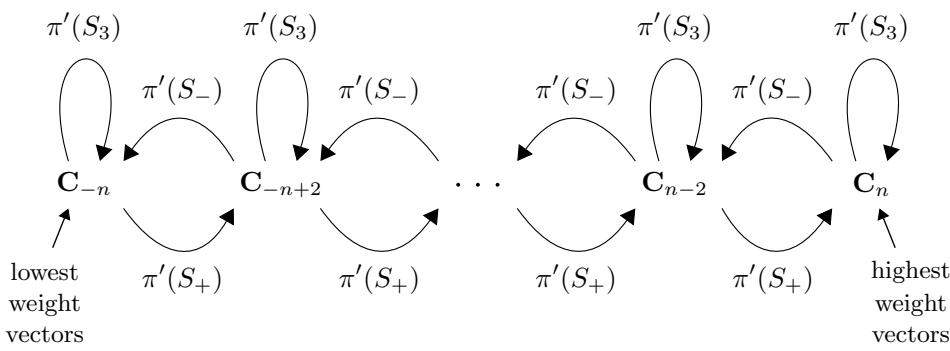
Figure 8.1: Basis for a representation of in terms of raising and lowering operators.
where all the vector spaces are copies of and all the maps are isomorphisms (multiplications by various numbers).
In summary, we see that all irreducible finite dimensional unitary representations can be labeled by a non-negative integer, the highest weight . These representations have dimension and we will denote them . Note that is the n’th weight space, is the representation with highest weight . The physicist’s terminology for this uses not n, but and calls this number the the representation. We have so far seen the lowest three examples , or spin , but there is an infinite class of larger irreducibles, with dim
来源与版本
正文:英文 · OCR 机器稿 · 待校对
核对状态:OCR 机器稿 · 待校对
原书 PDF · 印刷页 89、90、91、92、93、94、95、96、97、98、99、100、101、102、103、104、105、106、107、108
来源版本:2025-10-20
来源 PDF SHA-256:5a1941b2443b54d5db3d055f1e5ba390429b7a728475258017aaac87ee85a837
OCR 来源 SHA-256:f30e5e19104ce525fa7316f25353a05960c606085ccb5d251e1897c8bfa8c58c
OCR 产物 SHA-256:f30e5e19104ce525fa7316f25353a05960c606085ccb5d251e1897c8bfa8c58c